Wednesday, June 4, 2008

Wedding Dress And Japanese kimono Wedding Tradition

Kimono fitter dressed couple for their traditional Japanese ceremony in the Cotswolds.

Photographer Denis Kennedy, from Witney, had an unusual assignment in Chipping Campden — when he photographed the traditional Japanese wedding of engineer Ayao, 31, and Sachie Komatsu, 29, a PhD student.

The couple are both from Tokyo, but met in Oxford. They now live in Northampton.
For their ceremony in Britain the couple dressed in traditional Japanese style but, says Sachie, for their ceremony in Japan in December she will be wearing a western wedding dress!

The couple hired a Kimono fitting specialist to dress them and the wedding party. Sachie explained: “In the past, all Japanese obviously used to wear Kimono in their daily life. However, we rarely wear Kimono these days, since our country has been hugely influenced by western countries.
“The Kimonos we were wearing are for special occasions, so it’s necessary to have someone to help to put them on.

“The Kimono I was wearing is called ‘furisode’, and the sleeves are very long — they almost touch ground. This special Kimono
is for an ‘unmarried young lady’. It is our tradition to give the Kimono to a lady, when she celebrates her 20th birthday, which is the official adult age in Japan.

http://www.brideandgroomoxfordshire.co.uk

Wedding Dress: Japanese Bride Wedding Kimono In Wedding

The traditional white wedding kimono is called shiro-maku. Shiro meaning white and maku meaning pure. The Japanese wedding kimono actually consists of several different kimono. The white wedding kimono is worn for the wedding ceremony and an elaborate rich patterned silk brocade kimono called uchikake is worn over the white kimono at the wedding reception. The bride will normally change her dress several times, a tradition dating from the 14th century that signifies that she is prepared to return to everyday life.

The uchikake kimono originated in the Edo era and was mainly worn only by court nobles. The kimono is made of silk and beautiful silk brocade. The kimono is rich in fine embroidered patterns and scenes of flowers, cranes, pines, flower carts and nature motifs embellish the kimono in rich color. The wedding day will be the last time the bride will wear a rich highly patterned kimono, for in Japan they are reserved only to be worn by young unmarried women. Red is the most popular uchikake kimono color, however they are available in many different colors from imperial purple to sea green.

The brides hair is styled in the traditional hair style called bunkin-takashimada and adorned with beautiful kanzashi ornaments, combs and accessories.
A white wedding hood called a tsuno-kakushi literally meaning "to hide horns" is worn during the ceremony indicating that she will carry out her role as a wife with patience and serenity.
Like American weddings, there are traditional wedding accessories that are worn for tradition and are said to bring good luck. The bride carries a small purse style sack called hakoseko and a small encased sword called kaiken. Lastly, a fan is worn in the obi belt for tradition holds that the gradual widening of the open fan implies happiness and thus brings a happy.

http://www.japaneseweddingfavors.com

The Important Things In Selection and purchase of chinese wedding gown

Red is a color of luck, wealth, love and happiness, and as we choose a white color for a wedding dress, Chinese brides wear a red wedding gown. The more wedding gowns the bride changes during the wedding night, the more prominent the family is. Normally, a Chinese bride has three to four dresses. Although a white color is associated with death, you can often find Chinese woman, dressed in a traditional Western white dress, which shows a profound influence of the Western culture on Chinese. Wouldn't you agree that all uncommon to us looks more beautiful? While we admire Chinese traditions of clothes' design, they prefer ours.

If you are looking for a Chinese wedding gown, perhaps, a primary thing you think of, what designs are traditional and what ones are modern. A Chinese wedding gown is normally of red color, often embroidered with many designs, made of gold or silver thread. The most typical designs are of dragon and phoenix, which show the union of a male and a female.

The style of a Chinese wedding gown often emphasizes the origins of the family. Most of the dresses worn these days arise from the Qing dynasty, the last dynasty of China, and are called Qi Pao. Areas that are more northern would wear a Qi Pao, while brides from southern China usually wear a two-piece dress, named Qun Gua, Kwa or Cheongsam, also masterfully adorned with golden phoenix and dragon. There are also other styles of dresses in China, arising from the diverse cultures, inhabiting China and including Mongolian, Taiwanese, Tibetian and various minority groups that still find their homes in this hospitable country. The red characteristic has been a part of the ceremonies since probably the first introduction of weddings during the Warring States period. A red veil has also been a natural part of the bride's costume to cover her face during the wedding ceremony. Newlyweds would see each other's face for the first time at their wedding night.

We have gradually come to the most important question where to buy an authentic Chinese wedding dress for your Chinese wedding. The options are many, ranging from searching your nearby Chinese shops and browsing the Internet resources. If you prefer the second variant, here are some websites that offer Chinese wedding gown collections.

• ChinaBridal.com operates exclusively on the Internet. It is not only good for search of a particular Chinese wedding gown, but also a one-stop wedding planning resource center. You can find here all the information, services and products for your Chinese wedding. The products' shipping is available both: inside and outside the US.

• Bitablue.com is an online Chinoiserie boutique, owned by Bravochina L.L.C., introducing to you all the possible variety of Chinese wedding dresses. Here you can find handmade embroidery silk dresses, blue floral silk dresses, handmade sequin embroidery pure silk velvet dresses and many other options from traditional to mandarin style exclusive models.

• www.orienttouch.com carries a large collection of oriental style clothing, clothing accessories, gifts and home decor items, shipping to all major countries with most buyers from the USA, Canada, UK, Spain, Netherlands, Germany, Sweden, France, Australia and Japan.

Definitely, there are more variants worth considering; however, when purchasing your Chinese wedding gown, do not forget that in a modern Chinese wedding, the bride changes dresses at least three times. The first time it is a white western style wedding gown to symbolize the bride's purity. You will wear it to the church ceremony if you have one, if not, this is the dress you will wear to ascend the bridal car on the wedding day. The second dress is a red traditional Chinese Choengsam dress, also known as Qi Pao or Qun Kwa. You will wear this traditional Chinese dress to greet guests at the reception site and at the banquet. The third dress is an evening gown, when you see off the guests at the end of the wedding. Preserve traditions to make your Chinese wedding truly Chinese!

http://www.syl.com

Tuesday, June 3, 2008

Wedding Dresses: Germany Wedding Traditions


Germans respect and love their traditions and maintain them through time and distances. Foreigners travel to Germany and marry there, Germans living abroad wish to get married in accordance with their native rituals, so it is high time to get brides and grooms acquainted with what they will have to do on their German-like Hochzeit (wedding).

Wedding traditions in Germany differ from region to region. Here are some of the highlights:

Car Procession - after the wedding a car procession is formed and drives through town honking their horns - others honk back wishing the couple good luck.
Costs - the father of the bride has to pay the wedding. This is an old custom but today normally both parents and the couple itself divide the costs for the wedding.
Dance - the first dance is danced by the bride and the groom, it is traditionally a waltz. The next dance is only for bride with her father and groom with mother, while bride's mother dances with groom's father.
First Night - to make the first night as difficult as possible, friends of the couple do lots of funny or sometimes cruel things. They fill up the rooms with balloons, hide lots of alarm clocks in the bedroom, take apart the bed, and so on.
Flowers - besides the flowers for the bride and in church, the hood of the wedding car is decorated with lots of flowers.
Junggesellenabschied - a few days before the wedding the groom and his male friends go to a pub or sometimes other places to drink and have fun. (the last time?)
Kidnapping of the bride - in some areas (mostly in small villages) friends kidnap the bride and the groom has to find her. Normally, he has to search in a lot of pubs and invite all people in there (or pay the whole bill). Sometimes this ritual ends badly.
Polterabend - this is an informal (informal dress and food) party at the evening before the wedding where plates and dishes are smashed (the broken pieces are thought to bring good luck to the bride). The bride and groom have to clean up everything.
Rice - after the wedding when the bride leaves the church, friends throw rice on them and it is said that they will get as many children as rice grains stay in the hair of the bride.
Veil Dance - this is a popular game for a wedding evening. Every woman or man who wants to dance with the groom or bride, has to pay for it.
Wedding Cake - the wedding cake, mostly a large cake with lots of ornaments, has to be cut by the bride and the groom together.
Wedding Evening
- at the wedding evening a lot of games are played, speeches are held (the first normally from the father of the bride), sometimes a wedding newspaper is handed out. Songs are sung, and so on.
White Ribbon - the bride carries lengths of white ribbon with her bouquet, and after the church ceremony is over and the guests are leaving the church, she hands each driver a ribbon that they tie to the radio antenna.
Wedding Rings - Germans wear wedding rings on the right hand - the groom and the bride have normally identical rings (wedding "bands" -- no diamonds).
Wedding Shoes - another tradition is to collect pennies for years and buy wedding shoes for the bride with this money.
Wedding Attire (Bride) - as in America, the bride usually wears white with one difference: the gowns usually do not have any trains, and if they do, they are very short, and just a little sweep. Most brides prefer the good old ballroom style gowns, some of them have crinolines to be worn under the dress. Most German brides want the newest style wedding gown, and they browse the bridal boutiques and check out what is new and which style is best for them. However, I have been to weddings where brides wore short dresses or even a white suit.

Veils are usually fingertip length, and very seldom worn over the face when a bride walks down the aisle. Some brides (especially Catholic) wear veils that are the same length as their gowns. Some brides take their veils off during the reception, but NEVER before the first dance with their husband and their father. A veil is not a must. Some brides wear only a flowery headband with ribbons hanging down the sides or the back of their head, some prefer both the headband and the veil. Tiara's, little crowns and hats are also a often seen addition. Most brides carry a little draw string purse down the aisle, and also wear gloves. A bride stays in her wedding dress all day, not only a few hours as they do in America. Most receptions last until the early morning hours, and most brides will not change into a different outfit, but wear their gown the whole time. It is also customary for the bride to get dressed at home (most choose their parents home), and then drive to church already dressed in their gown. Most have a beautician come to the house to fix their hair, veil and make up as well.

Wedding Attire (Groom) - the grooms usually wear a black suit.
Wedding Party - bridesmaids, groomsmen or flower girls etc. are seldom to be seen at a German wedding. It is not customary. Also, usually the bride and groom enter the church together and walk down the aisle together. The reason for this is that in Germany it is not legal to marry "only" in a church ceremony. The couple has to be married by the justice of peace, or as in Germany called "Standesbeamte" first. This usually takes place a few days before the actual church ceremony. So when they marry in church they are actually already married by law. For this ceremony the couple, the closest family members and friends get together in the court house, and then the couple will be married by the "Standesbeamte." Usually afterwards is a dinner. For this type of wedding brides mostly either wear a 2-piece outfit (skirt and jacket) or an informal dress. Some choose white, especially if they don't have a church wedding to follow. Courthouse Weddings last about 30 minutes, church Ceremonies can last up to 1 1/2 hours and more. There is a lot of singing, praying, and a sermon as well.

I was also lucky to get the impressions of the witness who attended a wedding in Salzburg, and he described the event. The marrying couple had chosen a small church not far from Salzburg for the wedding. This is a rule to choose a "special" place for the Hochzeit, rather than the general rule in America of always having the wedding at the bride's family church. The groom's family have arranged everything for this wedding. There was a Catholic Mass, in German of course, and afterwards everyone went to a restaurant for wedding cake and tortes and coffee, then there was beer and "fun music" outdoors with a band from 4pm to 6pm, followed by a formal dinner, and then more music and dancing until midnight. It was truly a day-long party, and everyone had a lot of fun.

This is what a typical German wedding is like in general. But still there are special little details necessary to mention, like bride should carry salt and bread as an omen for good harvest, and the groom - grain for good luck and wealth. Before the wedding, the German bride's possessions would be transported to her new home. The belongings traditionally included linens which she had collected, a cradle into which a doll had secretly been placed, and the second-best cow from her parents' farm. These are only a few of authentic German wedding traditions, one of the most interesting and curious of the being Polterabend, when dishes are broken to scare away evil spirits. Take care: only china is used, as broken glass would bring bad luck. The tradition requires the bride and groom clean up the mess - the first mess to cope with!

Log-sawing is another wedding tradition from Germany. It is done after the wedding ceremony. There will be a log on this log sawing horse and when the newly wed couple comes out of the church it awaits them as the first task they have to accomplish together as a married couple. It is supposed to show how they will manage to accomplish tough tasks in the future. It might be really interesting if bride and groom were not dressed in a white gown and tuxedo...

Another wedding tradition coming from Germany involves the bride and groom carrying candles trimmed with flowers and ribbons. However, even in Germany wedding traditions and rituals differ from town to town.

The article was published with the permission of
GermanCulture.com.ua. See link for Germany wedding traditions

Monday, June 2, 2008

Wedding Kimono In Japanese Bride


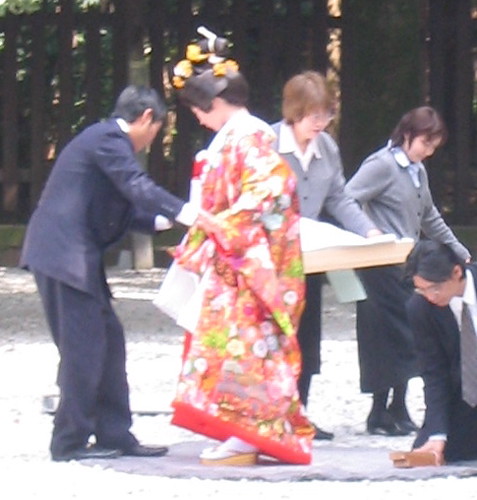
The traditional white wedding kimono is called shiro-maku. Shiro meaning white and maku meaning pure. The Japanese wedding kimono actually consists of several different kimono. The white wedding kimono is worn for the wedding ceremony and an elaborate rich patterned silk brocade kimono called uchikake is worn over the white kimono at the wedding reception. The bride will normally change her dress several times, a tradition dating from the 14th century that signifies that she is prepared to return to everyday life.

The uchikake kimono originated in the Edo era and was mainly worn only by court nobles. The kimono is made of silk and beautiful silk brocade. The kimono is rich in fine embroidered patterns and scenes of flowers, cranes, pines, flower carts and nature motifs embellish the kimono in rich color. The wedding day will be the last time the bride will wear a rich highly patterned kimono, for in Japan they are reserved only to be worn by young unmarried women. Red is the most popular uchikake kimono color, however they are available in many different colors from imperial purple to sea green

The brides hair is styled in the traditional hair style called bunkin-takashimada and adorned with beautiful kanzashi ornaments, combs and accessories.
A white wedding hood called a tsuno-kakushi literally meaning "to hide horns" is worn during the ceremony indicating that she will carry out her role as a wife with patience and serenity. Like American weddings, there are traditional wedding accessories that are worn for tradition and are said to bring good luck. The bride carries a small purse style sack called hakoseko and a small encased sword called kaiken.

Lastly, a fan is worn in the obi belt for tradition holds that the gradual widening of the open fan implies happiness and thus brings a happy future.

http://www.japaneseweddingfavors.com